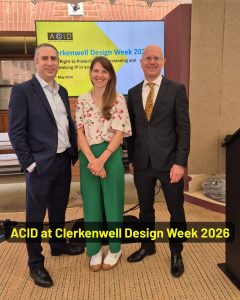


At the Global IP two day conference on the Power of Designs organised by the International Trade Marks Association (INTA) on Feb 26/27 ACID CEO Dids Macdonald, OBE delivered an impassioned plea on behalf of many UK designers who consistently experience design infringements to a packed audience of around 300 international IP lawyers.
The aim of the conference for leading business and legal experts was to teach them how to harness the power of designs and navigate the challenges and opportunities of design rights.
Imitation isn’t flattery if it costs you your livelihood and it nearly cost me mine. It is a sanitised word for theft. We were a tiny but successful design outfit and every time we brought out a new product it was copied. Drastically!
Although we had registered our designs, it became prohibitively expensive to pursue the copyists. The time this took for a small business side tracked us from our main work to earn a living – designing beautiful products. Most designers are fairly passionate and the emotional drain of legal pursuit was nothing short of de-motivating and mentally exhausting.
The first instance of alleged copying was by a major, well known UK retailer. I had taken my new designs in to be considered by the design buyer but they were too expensive. A couple of months later we discovered remarkably similar designs being sold in one of their flagship stores in their 100’s. They had been sent out to Portugal with instructions to use one half of one design and the other half of another design to create a new design. However, we successfully challenged them and whilst they did not admit liability, they paid us costs and we received undertakings from the UK distributor, Portuguese manufacturer and the Retailer.
I was so outraged at this alleged blatant infringement of our registered designs I co-founded Anti Copying in Design (ACID) to try and help small design companies such as ourselves who were being consistently copied.
Today, ACID represents thousands of designers in all shapes and sizes from many design disciplines. And IP education & awareness, prevention, deterrence & support are its cornerstones to help IP protection and raise awareness of the devastating impact of IP theft on jobs and job security. Becoming IP savvy is the name of the game and creating a proactive IP strategy a must!
20 years ago another reason I co-founded ACID was because designs were simply not in the language of IP rights by the then UK Patent Office or Government. A Cinderella right, many called it but design is now very much at the heart of the creative industries and on IP radar nationally and internationally. WHY? Because the majority of UK SME designers, as was I, cannot afford the luxury of litigation. 20 years is a long time for Design to be centre-stage at an international conference. So I am even more delighted at this seismic change
Many say, it is a golden time and growing faster than any other sector but the language of design is not confined to any IP right solely or any sector or organisation.
21st century design spans the economy in a unique way making products, services and systems more useful and some or all IP rights are a component or components underpinning this sector.
Interestingly 80% of this amazing workforce producing significant output for the UK economy have less than 10 employees and 67% have less than 4 employees.
So, it is a truism when thinking about Design and IP – one size definitely doesn’t fit all needs!
But there are common themes binding the design economy together
In Alliance research, we asked how important IP is and this gives some insights – basically, to earn a living from what you create, capitalise on IP to achieve growth & send a clear message IP cannot be used without permission.
The common theme was,“I need to understand & identify what IP I own, how I can leverage it better to achieve growth and make change for the better.”
Just look at this excellent example of effective licensing to maximise IP. Penguin had the vision to see the potential – the designer made it happen by creating these great associated products.
Intellectual capital is a critical asset & the DNA running through most design sectors that needs to be identified, valued and protected to achieve growth. It’s about know-how, trade secrets – the intangible value of a business covering its people, relationships and its structural capital of which IP is but one component.
Some of you may not be aware that the majority of UK and EU designers rely on unregistered UK and EU design rights & may say, well, where’s the proof and why don’t designers register their rights?
Surprisingly, although there has been an increase in the UK only just over 8000 designs were registered and in the EU although there are approximately 85,000 registrations per annum, this only equates to an average of 3000+ per country although the UK is slightly higher than average at around 5500 per year. But these figures represent designs from an entire country or the whole of the EU, currently 28 member states last time I looked!
To put this into perspective, ACID’s IP Databank for copyright and unregistered designs receives around 25,000 annually – 3 times the number the UK IPO receives for the entire country. The ACID IP Databank holds over 300,000 lodgments and is an effective independent evidence gathering tool for new designs, copyright works and when pitching. There is option of a unique, tamper proof number and certificate supported by Police Intellectual Property Crime Unit PIPCU.
So what are the reasons we believe the reasons for such low registrations
Often it is David, (lone micro or SME with few funds) against Goliath (major retailers or behemoth manufacturers, with deep legal pockets) whose strategy is to stonewall any challenge and perpetuate litigation, leaving the alleged copyist to carry on selling and blowing the little guy out of the water.
After Trunki, many designers said why bother registering? I tend to agree. Trunki is a classic example of not being able rely on their registered design which proved insufficient in the Judgment handed down. Many also said it was a classic case of unfair competition
Designers tend to think graphically rather than linearly and at ACID we tried to simplify the guidelines into 3 easy steps – basically what you submit is what you have to rely on. Show a design in a line drawing, show the design in grey scale and register all designs with all possible surface decorations in colour combinations to be safe.
A sage lesson which cost Trunki nearly one million pounds at the end of the day. So, sadly, litigation is not an option or luxury for most SMEs not least because of the affordability of legal advice to pursue infringement. Average hourly earnings over 8 design disciplines, 16.84 pounds per hour doesn’t buy much when one considers IP lawyers fees of anything between 200 pounds and 500 pounds per hour. A compelling reason there have been so few design cases proportionate to the proliferation of design theft.
But now many are taking to social media. Often, exasperated SMEs versus big brand. There is an example of an SME not being able to afford to take their action against a Retailer any further. On the presentation is an example of how a design on a T shirt, an ACID member’s design, was used without permission. After failing to get any progress through a legal route she turned to social media. The Retailer stopped selling the T shirt.
But ACID cases are not always David & Goliath. Only recently a relative Goliath v Goliath case resulted in a landmark victory for ACID members Halo in the US – a Landmark victory in that Halo relied on copyright in a design case. We are going to shout very loudly about it and name and shame through our spot the copy initiative. Naming and shaming is a key part of a proactive IP strategy but with care.
So we welcome any interest from major design brands to be our corporate ambassadors and support the work we do!
Here, from a trade organisation perspective is a snapshot of just some of the tips we share with SMEs to enable them to create a proactive IP strategy
It’s about knowing your design right from your copyright, your trade marks from your patents and also understanding the myths surrounding IP. For example many still think by making a % or number of changes to a design it becomes a new design. It doesn’t. Design infringement, which many designers do NOT know, is whether an alleged copy makes a different overall impression on the informed user. For copyright infringement the test is qualitative test not quantitative again, this is another one of many IP myths. Can I patent my design is another!
We stress the importance of looking after their trade secrets and know-how. After all it is what sets them against a competitor to steal the march to harness growth.
Creating simple agreements for confidentiality or non-disclosure is such simple advice but so few do. Especially good when creating collaborative work. Clarity of IP ownership is essential and it’s good to have the small print to rely on.
Manage Risk – identify if anyone is using a designer’s creative work without permission, seek advice, keep watch and name and shame (with caution!)
There is a specially designed ACID Brand Enforcement Service if online infringement is discovered and a fast track route to private prosecution through Kounoupias IP. Nick Kounoupias has significant experience and an excellent track record.
Going back to David v Goliath our advice to SMEs if they are unlucky enough to be copied is to choose battles carefully, have proof of design ownership and demonstrate a quantifiable loss.
If designers don’t want to be copied, they need to say so!
And no better place than a 24 hour alarm on your website like the Member of ACID logo, outwardly communicating the value of IP to all.
A simple statement such as “All intellectual property rights in our designs/website/marketing material/technical specifications belongs to (insert the name of the company). Any infringements will be taken seriously”. Written at the bottom of each website page provides a strong deterrent message. Even better if the ACID logo is adjacent because it says what it does on the tin. “I am a member of a high profile organisation against IP theft”.
Having a dedicated website page on IP is also another good plan together with a simple statement outwardly communicating IP ethics and compliance of ones IP respect of others.
We advise our members to identify where there export markets are, where is your IP support. Do you know about the IP attaches in BRIC countries etc. Register where possible.
If you’ve got a good idea keep it safe, careless talk can cost the competitive edge
IP respect, compliance and ethics should be at the heart of your own IP strategy and outwardly communicated to raise basic standards of CSR
Mediate don’t Litigate, good advice for lawyers dealing with SMEs, the potential of a client for life as well as being a cost & time effective ADR!
Consider registering your designs – register if at all possible and Brexit proof while you can.
And the all important trade mark. We emphasise the value of registering a company name as a trade mark to enhance brand protection. Everything built up either under a designers name or company name adds value to the brand we consistently reinforce. Again, Brexit proof while you can is an ongoing mantra!
ACID is a campaigning organisation and very concerned about the potential loss of unregistered EU designs. Why? Because it is a much broader design right than UK unregistered design because it includes surface decoration and offers protection in 28 member states. Copyright will be about nuanced issues but EU unregistered rights are critical for the majority of designers
And what of the future in a proactive IP strategy of deterrence and prevention? I will touch v briefly on 3D printing and an ACID case study. Hailed as part of the 4th Industrial revolution from customised automotive & aviation components to prosthetics and orthopaedic implants not to mention prototyping of different design led products. “Make as you need” is transforming the ability to be economically viable to create one-off objects.
Last year even a building was created using 3D printing
And here is an example of ACID member Morgan furniture using a combination of traditional methods AND 3D printing. 2 years ago one could only produce 1 type of wood through 3D printing, now there are around 12 different wood types.
But as the majority of UK designers rely on unregistered design rights, still not a crime, any future infringements through 3D printing will very difficult and expensive to enforce.
At a conference we held in November 2016 to raise awareness about the lack of momentum in creating a law to deal with what we believe will be a potentially dangerous situation for designers through 3D printing infringement, this is a quote from DCI Mick Dodge of PIPCU,
“With 3D printing machines readily available to consumers this is a ‘one stop shop’ for criminal activity. But where is the legislation? I cannot act or enforce without a law to enforce – I need some legislation to work with to create an investigation strategy?”
In 2014 after a significant campaign ACID spearheaded a change in UK law and the intentional infringement of a registered design is now a crime punishable by up to 10 years in prison. The aim behind our campaign was deterrence. Just as Sir Robert Peel created the Metropolitan Police back in the 1800’s it wasn’t to put everyone in prison but to act as a real deterrent against crime. And we succeeded with not one single ounce of support from British legal bodies. To the extent that one Judge wrote an article in a Parliamentary publication saying “Do not listen to the shrill voice of ACID”.
Recent research stats underpin our resolve. 90% said design infringement was blatant and deliberate!
Our ongoing campaign will be to ensure that the intentional infringement of an unregistered design is also a crime. With no law to enforce and 3D printing already providing some worrying evidence. It cannot come too soon
From iconic to every day, design is all around us enriching our lives as consumers. Solving problems, adding value and empowering social economic improvement. And its a great communicator too!
Design matters, it is one of the UK’s most valuable assets and we need to protect it to ensure continued growth. A united voice is a strong voice.
Spread the Word
| Cookie | Duration | Description |
|---|---|---|
| cookielawinfo-checkbox-analytics | 11 months | This cookie is set by GDPR Cookie Consent plugin. The cookie is used to store the user consent for the cookies in the category "Analytics". |
| cookielawinfo-checkbox-functional | 11 months | The cookie is set by GDPR cookie consent to record the user consent for the cookies in the category "Functional". |
| cookielawinfo-checkbox-necessary | 11 months | This cookie is set by GDPR Cookie Consent plugin. The cookies is used to store the user consent for the cookies in the category "Necessary". |
| cookielawinfo-checkbox-others | 11 months | This cookie is set by GDPR Cookie Consent plugin. The cookie is used to store the user consent for the cookies in the category "Other. |
| cookielawinfo-checkbox-performance | 11 months | This cookie is set by GDPR Cookie Consent plugin. The cookie is used to store the user consent for the cookies in the category "Performance". |
| viewed_cookie_policy | 11 months | The cookie is set by the GDPR Cookie Consent plugin and is used to store whether or not user has consented to the use of cookies. It does not store any personal data. |