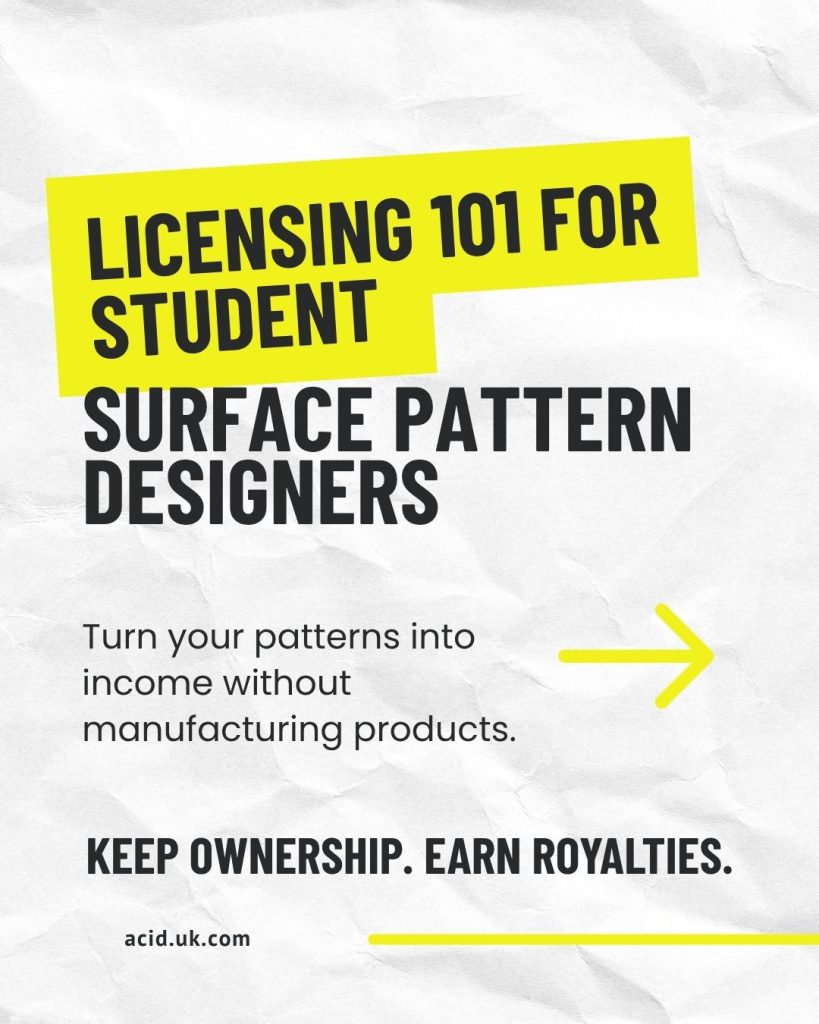
If you’re a student or emerging designer, understanding surface pattern design licensing is one of the most valuable skills you can develop. It allows you to earn income from your designs while retaining ownership, helping you build a sustainable creative career.
In this guide, we break down the essentials of licensing, copyright protection, and best practices, so you can confidently protect and monetise your work.
Surface pattern design licensing is creating a legal agreement where a designer gives permission for a business to use their design on products.
This can include:
The key point? You still own the intellectual property (IP) rights in your design.
Licensing allows companies to reproduce and sell your work, while you retain ownership..
Licensing is a powerful business model for creatives, especially those starting out.
Key benefits include:
For student designers, this means you can focus on creating, while your designs generate income commercially.
One of the most important things to know:
Your design is automatically protected by copyright law the moment you create it.
This gives you exclusive rights to:
If someone uses your design without permission, it is considered copyright infringement; a serious legal issue that can result in financial loss and reputational damage.
That’s why understanding your rights early is essential.
Not all licensing deals are the same. Understanding your options helps you make better commercial decisions.
Clear agreements protect both your designs and your income.
To succeed in surface pattern design licensing, you need more than creativity; you need strategy.
Verbal agreements are risky. Ensure everything is documented clearly, including rights, payments, and usage.
Before signing any agreement, check:
While copyright is automatic, you should keep evidence of the creation of your designs in case a dispute ever arises.
Keep an eye on:
Early detection is key to protecting your work.
With the rise of online platforms, design theft has become more common, faster, and easier.
To safeguard your work:
Being proactive helps prevent misuse and strengthens your ownership claims.
Protecting your IP doesn’t have to be overwhelming. ACID provides dedicated support for designers at every stage of their career.
With the right support, you can confidently protect, enforce, and commercialise your designs.
Visit ACID’s Student Membership page to protect your ideas before someone else profits from your creativity.
To support stronger IP for everyone, you can sign the ACID IP Charter.
Spread the Word
Latest News
Newsletter Sign-Up
| Cookie | Duration | Description |
|---|---|---|
| cookielawinfo-checkbox-analytics | 11 months | This cookie is set by GDPR Cookie Consent plugin. The cookie is used to store the user consent for the cookies in the category "Analytics". |
| cookielawinfo-checkbox-functional | 11 months | The cookie is set by GDPR cookie consent to record the user consent for the cookies in the category "Functional". |
| cookielawinfo-checkbox-necessary | 11 months | This cookie is set by GDPR Cookie Consent plugin. The cookies is used to store the user consent for the cookies in the category "Necessary". |
| cookielawinfo-checkbox-others | 11 months | This cookie is set by GDPR Cookie Consent plugin. The cookie is used to store the user consent for the cookies in the category "Other. |
| cookielawinfo-checkbox-performance | 11 months | This cookie is set by GDPR Cookie Consent plugin. The cookie is used to store the user consent for the cookies in the category "Performance". |
| viewed_cookie_policy | 11 months | The cookie is set by the GDPR Cookie Consent plugin and is used to store whether or not user has consented to the use of cookies. It does not store any personal data. |