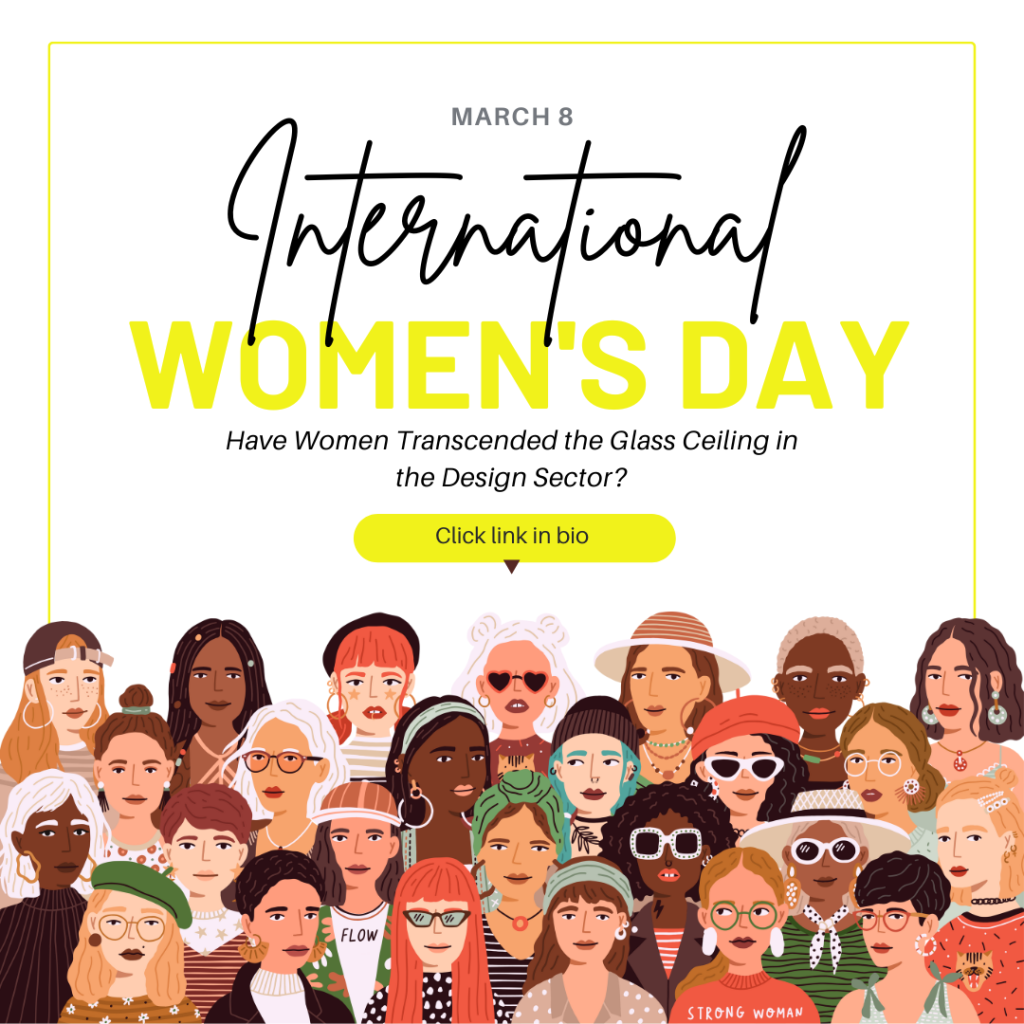
International Women’s Day is a good time to celebrate women in design and show how their ingenuity, innovation, creativity, and success breathes life into the creative industries and design sector. However, many ask whether women have really become equal overall and transcended the “glass ceiling in design”, and if not, what can be done to redress the balance? The World Intellectual Property Organisation is choosing to campaign for women to have more representation in the landscape of IP and is therefore making Women and IP this years theme for World IP Day 2023 on 26 April.
Women are certainly present in all areas of design, but in some, more dominant, such as graphic design, crafts, fashion, and art. Women tend to be equal to men at entry level, so there is not an issue with women’s desire or eligibility to have important roles in design. However, women are not entering the higher echelons of business at a rapid enough rate. In fact, in more senior management, the rate is closer to stagnation and inclusivity on executive boards and women CEOs are few and far between.
Laura Bolt, Eye on Design, said, “The history of design has been written by both women and men, but there have been times when it was difficult to see where women have had a seat at the table, and just how significant their contributions have been.”
In 2016, the Design Council reported that the design workforce was 78% male and only 22% female. In 2023, it is reassuring to see that since then in the graphic design sector, for example, more than 60% are now women. Bolt identified from the 2019 AIGA Design Census, 61% of designers working today are women. The rate of female creative directors across the industry rose from 3% in 2008 to 29% today. This shows a positive move towards design sector diversity.
Pipeline created a report in October 2022 examining women’s positions in major plcs. Equality at entry level, is positive though the rate at which women can climb the ranks is far lower. Pipeline’s 2022 report shows there is still a way to go.
Eve Maddock-Jones, Investment Week, reported, “Only 4% of CEOs among FTSE 350 companies are women.”
It was further reported that 74% of the FTSE 350 executive committee members were men and 10% had no women at all. Sadly, 70% of businesses main boards have no female executive directors. Sky news’ review of Pipeline’s report highlighted that when a business has a female CEO, these companies are more likely to have women rising to higher positions. With a female leader, the proportion of female executives on the main board are 63% as opposed to 14% with men at the helm.
These are eye-watering figures when the design workforce is on average, higher than 50% women. The evidence indicates that more women leaders enable and encourage other women to climb up the ladder leading to a more inclusive management representation.
In the fashion sector, for example, which tends to be at the lower end of the economic spectrum, women feature more heavily. Whereas men dominate in areas such as industrial or architectural design. This clearly demonstrates that there are not only disparities between men and women in the seats of power, but also in terms of pay.
ACID member, Charlotte Raffo, Founder of The Monkey Puzzle Tree, said, “It’s easy to feel stereotyped as a female with a creative business that it’s somehow a less serious proposition than a business started by a male entrepreneur.”
World IP Organisation states, “Too few women are participating in the intellectual property (IP) system. That means too few women are benefitting from IP.”
ACID have a large amount of creative and innovative women in our community, all of whom view their IP as a positive force for growth. The design industry is not lacking from women’s ideas, ambition, or contribution, but we do know how difficult it is for designers to stand up against copycats. Even more so, when female designers are at the lower end of the pay wall, and the infringers, can sometimes be large companies and businesses with endless resources to support them. Does the issue of women protecting and fighting for their IP rights, become an issue of economic consideration by those who copy?
Dids Macdonald OBE., CEO of ACID, said, “I don’t think that necessarily gender comes into the strategies of big businesses who consistently copy but what we do know is that there is a deliberate strategy to choose cutting edge designs, copy them and then rely on the fact that in a David & Goliath scenario, few lone, micro and SME’s have the funds to challenge deliberate infringement. This status quo must change. We do though, have many examples of women designers who have had to fight enormously difficult battles when their designs have been replicated. Take talented designers Jess Linklater against Cos, Rachel Taylor against M & S and lately Chris Dunford against Aldi.”
Thankfully, society has changed recently over the last couple of years. Social media now, has such a strong influence on who is visible in design, which allows more equality and diversity. The shift post-pandemic to extended remote working means women can engage in business and design to a larger extent, as it creates a finer balance between family responsibilities and career ambition. Large companies are identifying that diversity needs to be more visible in the media, and more marginalised groups have the desire to be positively represented.
World IP Day is on the 26th April 2023, this year’s theme is Women and IP: Accelerating innovation and creativity. So, between International Women’s Day and World IP Day, ACID is going to highlight various successful women from our design community who have pushed the boundaries of gender in the design industry. We will bring you a series of interviews and posts where they share their thoughts and experience of women in design and, hopefully, shed some light on how the design industry can make moves to further broaden its diversity.
Resources and Quotes:
Spread the Word
Latest News
Newsletter Sign-Up
| Cookie | Duration | Description |
|---|---|---|
| cookielawinfo-checkbox-analytics | 11 months | This cookie is set by GDPR Cookie Consent plugin. The cookie is used to store the user consent for the cookies in the category "Analytics". |
| cookielawinfo-checkbox-functional | 11 months | The cookie is set by GDPR cookie consent to record the user consent for the cookies in the category "Functional". |
| cookielawinfo-checkbox-necessary | 11 months | This cookie is set by GDPR Cookie Consent plugin. The cookies is used to store the user consent for the cookies in the category "Necessary". |
| cookielawinfo-checkbox-others | 11 months | This cookie is set by GDPR Cookie Consent plugin. The cookie is used to store the user consent for the cookies in the category "Other. |
| cookielawinfo-checkbox-performance | 11 months | This cookie is set by GDPR Cookie Consent plugin. The cookie is used to store the user consent for the cookies in the category "Performance". |
| viewed_cookie_policy | 11 months | The cookie is set by the GDPR Cookie Consent plugin and is used to store whether or not user has consented to the use of cookies. It does not store any personal data. |