 On Friday, ACID’s Dids Macdonald took part in the Beijing IP symposium and a panel discussion on enforcement and shared these thoughts:


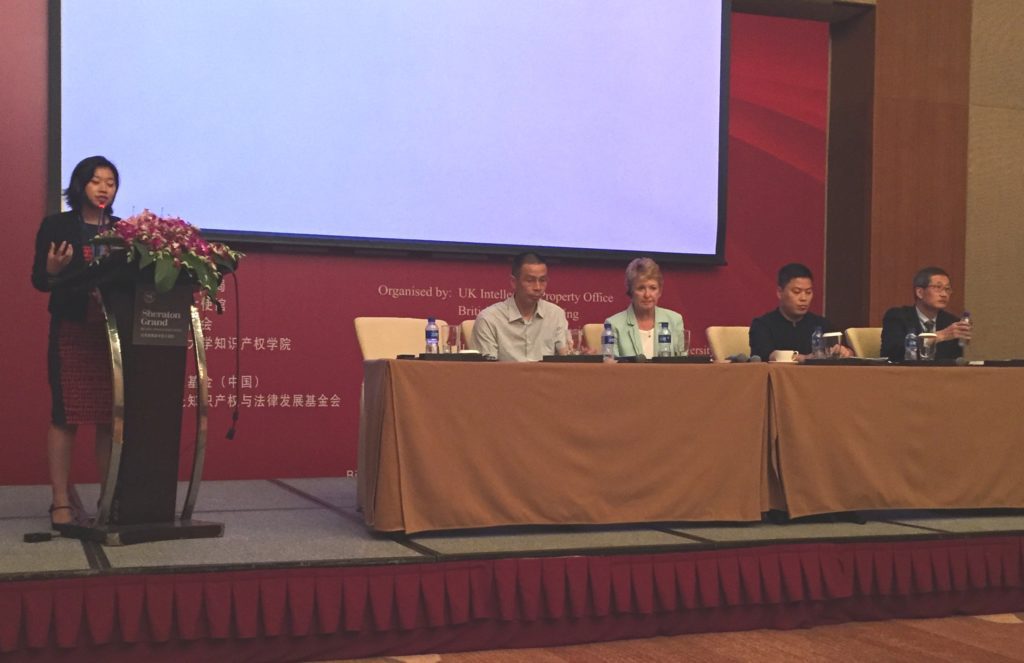
As Vice Chair of the Alliance I work with digital branded and design industries and my role in Anti Copying in Design is to work with UK designers. The majority of the creative industries including designers are micro and SME so the challenges of enforcement are many. 1.6 million are employed and this incredible vast, army and produce a staggering 74 billion to our UK economy and it is growing faster than any other sector in the UK.
Intellectual property is at its very heart but pursuing IP infringement is a cost & time prohibitive exercise and threatens job certainty. ACID’s objectives, quite simply, are IP education, prevention, deterrence and support and working towards even closer global collaboration. This is my second visit to China and it has provided a valuable insight in to the significant cooperation between UK and China. The IP framework in China is relatively new, only 20 years or so and the UK Intellectual Property Office (formerly the Patent Office) has been a key influencer in the evolvement of the China IP system over the last 20 years.
2. WHERE ARE THE IP ISSUES?
In the UK, for many designers the problems are discovering infringement online through counterfeiting, piracy and the discovery of slavish copies. At first point of market entry, discovering knock-offs at the exhibition venue is also an issue. Sadly, too, copying is generated by some major retailers who seek the fast track to market through unauthorised copies. Working in overseas markets where understanding of different systems of access to justice provides both a cost and awareness challenge. Designers often find their competitors are often some of the perpetrators.
3. WHAT ARE WE DOING ABOUT ENFORCEMENT IN THE UK?
We are one of the very countries in the world to have an IP Minister, Baroness Neville Rolfe and we are proud of the establishments of the UK IP attaché initiative with whom we work closely. This valuable connectivity cannot be underestimated and, as a result of my fist visit to China in 2014 with the delegation, I started an ACID IP China group to share information, intelligence, best practice and connect UK international policy makers with designs brands.
British Embassy, IP Attaché, China CBBC – working collaboratively we have produced a design IPR fact sheet similar to those that exist in china for the Film and Publishing industries
Design – we work with the Police Intellectual Property Crime unit, again one of the first in the world through where access to help on take down and track down and brand enforcement is available. They carry out raids on counterfeited and pirated products.
ACID has worked with PIPCU to create a publication called DESIGN OUT IP CRIME– an educational & awareness programme with guidelines on how NOT to infringe the rights of others, mainly aimed at those who do infringe such as some major retailers and manufacturers.
Working closely with Online platforms – only recently ACID held a meeting with Alibaba and its senior US enforcement management in London to discuss:
Notice & track down is particular close to our hearts and we have opened positive ongoing dialogue; swift removal of problem listings, a willingness to suspend accounts. Warning messages in key product categories.
We have been impressed this week by Tencent and Huawei’s declaration about respect for IP as a top line commitment, the same we witnessed with Alibaba. The proof will be walking the talk.
The door has opened with Alibaba for negotiations to take place for the ACID Databank to be used as evidence for unregistered design and copyright infringement. The ACID Copyright & Unregistered Design Database holds approximately 300,000 copies of our member’s designs.
Matthew Bassiuer, newly appointed Head of IP Global Enforcement, and the senior management team wish to create a Users Advisory Board. We have also held positive conversations to ensure that this has micro and SME representation at a global level to continue collaboration and consistency.
Mediate don’t litigate – ACID has intervened at grass roots at first point of market entry – the exhibition marketplace where over 4000 mediations have taken place. ACID’s mediation have had 70% success rate with one to one conversations. Of the remaining 27%, these have been resolved with Cease & Desist letters and/or undertakings. Only 3% have reached a final court hearing. It’s good to talk.
Government – UK has made it crystal clear that “IP Enforcement in all its forms is a clear priority to support our creative industries”. This message is consistently reinforced by the Minister for Intellectual Property, Baroness Neville-Rolfe.
The Judiciary – The Intellectual Property Enterprise Court was established as a cost & time effective Court process with minimum procedure. A small claims track is also available
4. WHAT WE WOULD LIKE TO HAPPEN
A global articulated commitment within corporate social responsibility – declare ethics compliance and IP respect and a change in the culture that it is OK to steal ideas and IP and free ride on another’s creative equity. An expectation rather than not.
Unuathorised use of another’s intellectual property whether it is property or intellectual propery is unacceptable. Replica, for example is a sanitised word for FAKE. Fakes are never in fashion
The introduction of more exemplary damages to act as a deterrent.
Criminal provisions for unregistered design infringement
5. WHERE ARE THE NEXT IP ISSUES COMING FROM?
3D Printing
Take a look at history! From vinyl to digital, Betamax to VHS and printing to laser printing. All of them caught the sectors unprepared legislatively to deal with the legal problems which arose.
Currently, as most designers rely on unregistered design law, certainly in the UK and EU there are few laws which will prevent counterfeiters finding the back door to unauthorised and easy bespoke manufacturing. ACID is holding a conference in November to gather stakeholders together and to debate and discuss the issue and we hope to provide thought leadership to influence policy to be proactive rather than reactive.
Spread the Word
Latest News
Newsletter Sign-Up
| Cookie | Duration | Description |
|---|---|---|
| cookielawinfo-checkbox-analytics | 11 months | This cookie is set by GDPR Cookie Consent plugin. The cookie is used to store the user consent for the cookies in the category "Analytics". |
| cookielawinfo-checkbox-functional | 11 months | The cookie is set by GDPR cookie consent to record the user consent for the cookies in the category "Functional". |
| cookielawinfo-checkbox-necessary | 11 months | This cookie is set by GDPR Cookie Consent plugin. The cookies is used to store the user consent for the cookies in the category "Necessary". |
| cookielawinfo-checkbox-others | 11 months | This cookie is set by GDPR Cookie Consent plugin. The cookie is used to store the user consent for the cookies in the category "Other. |
| cookielawinfo-checkbox-performance | 11 months | This cookie is set by GDPR Cookie Consent plugin. The cookie is used to store the user consent for the cookies in the category "Performance". |
| viewed_cookie_policy | 11 months | The cookie is set by the GDPR Cookie Consent plugin and is used to store whether or not user has consented to the use of cookies. It does not store any personal data. |