
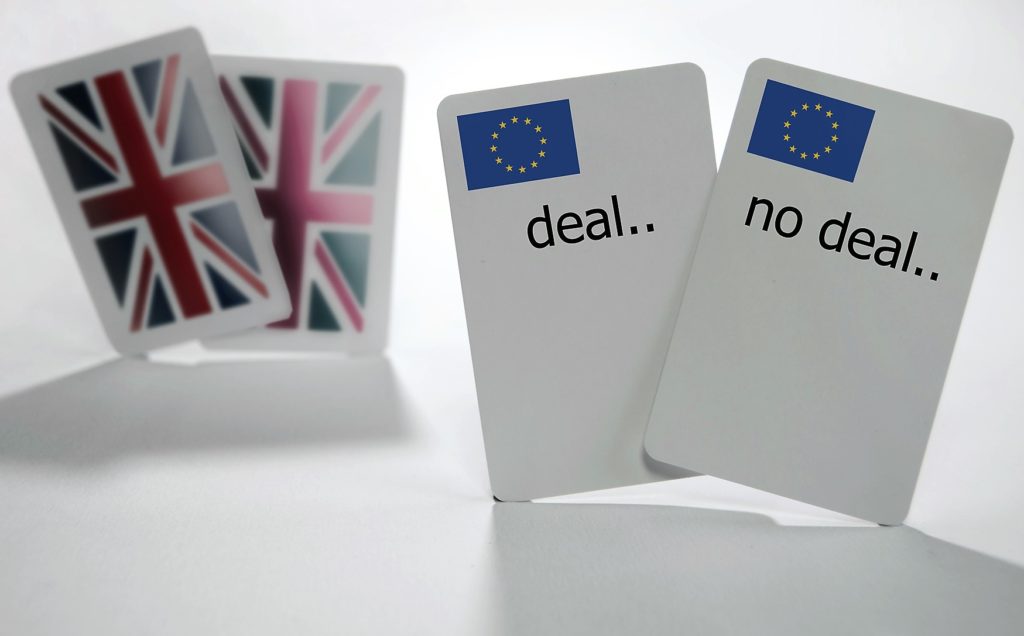
The Department for Exiting the European Union has produced a website providing advice to businesses on preparing for the UK’s exit from the EU, which they hope will provide some useful information.
Leaving the EU means businesses may need to prepare for change. Government confirms that delivering a deal negotiated with the EU remains a top priority. With an implementation period until December 2020, this would have given businesses and organisations stability, certainty and time to prepare for the new relationship after Brexit. However, in preparation for leaving without a deal, businesses and organisations may need to act before 31st October 2019.
On intellectual property The Government has summarised changes to copyright, exhaustion of intellectual property rights and included some basis facts on IP and Brexit including information on patents, trade marks and designs. The changes to designs are particularly significant to ACID members. Further information about designs can be seen here.
The Intellectual Property Office has also published a factsheet on intellectual property rights and Brexit.
Commenting on the loss of EU Community design right in EU27 following Brexit, deal or no deal, Nick Kounoupias ACID Counsel said: “Whilst the country remains gripped with talk of deal, no deal, prorogation and backstop, designers face continued uncertainty and existential threat from the prospect of being unable to protect their unregistered designs in the 27 EU member states post Brexit if these designs are first published outside of the EU , which would be the case if they were first published in the UK. This is clearly a worrying state of affairs but sadly Government has to date offered no comfort to designers, which this is unacceptable to ACID.”
To summarise:
Registered EU Trade Marks and Registered Community Designs – The government will ensure that the property rights in all existing registered EU trade marks and registered Community designs will continue to be protected and to be enforceable in the UK by providing an equivalent trade mark or design registered in the UK. Right holders with an existing EU trade mark or registered Community design will have a new UK equivalent right granted that will come into force at the point of the UK’s exit from the EU. The new UK right will be provided with minimal administrative burden. The trade mark or design will then be treated as if it had been applied for and registered under UK law.
Key points: No deal.
Unregistered Community after the UK leaves the EU if there’s no deal
The government will ensure that all unregistered Community designs which exist at the point that the UK leaves the EU will continue to be protected and enforceable in the UK for the remaining period of protection of the right.
In addition to this, the UK will create a new unregistered design right in UK law which mirrors the characteristics of the unregistered Community design. This means that designs which are disclosed after the UK exits the EU will also be protected in the UK under the current terms of the unregistered Community design. This new right will be known as the supplementary unregistered design right.
Those UK unregistered design rights which exist at the point of exit will continue to be protected and the UK unregistered right will continue to exist for designs first disclosed in the UK. The UK will amend legislation to ensure that it functions effectively once the UK is no longer part of the EU system for designs.
Implications:
UK, EU and third country designers will be provided with continued protection for those designs first disclosed in EU27 member states and already protected by an unregistered Community design right at the point that the UK exits the EU. Through the new supplementary unregistered design right, designs which are disclosed in the UK after the UK exits the EU will be protected in the UK under the current terms of the unregistered Community design.
From that point:
Actions for businesses and other stakeholders:
The protection of existing unregistered Community designs in the UK will continue through a new equivalent right which arises automatically and with no action required by the right holder. For eligible designs disclosed after exit, the supplementary unregistered design right will arise automatically.
Businesses may wish to seek legal advice on how these arrangements could affect their business model or intellectual property rights.
Spread the Word
Latest News


Newsletter Sign-Up
| Cookie | Duration | Description |
|---|---|---|
| cookielawinfo-checkbox-analytics | 11 months | This cookie is set by GDPR Cookie Consent plugin. The cookie is used to store the user consent for the cookies in the category "Analytics". |
| cookielawinfo-checkbox-functional | 11 months | The cookie is set by GDPR cookie consent to record the user consent for the cookies in the category "Functional". |
| cookielawinfo-checkbox-necessary | 11 months | This cookie is set by GDPR Cookie Consent plugin. The cookies is used to store the user consent for the cookies in the category "Necessary". |
| cookielawinfo-checkbox-others | 11 months | This cookie is set by GDPR Cookie Consent plugin. The cookie is used to store the user consent for the cookies in the category "Other. |
| cookielawinfo-checkbox-performance | 11 months | This cookie is set by GDPR Cookie Consent plugin. The cookie is used to store the user consent for the cookies in the category "Performance". |
| viewed_cookie_policy | 11 months | The cookie is set by the GDPR Cookie Consent plugin and is used to store whether or not user has consented to the use of cookies. It does not store any personal data. |